The full file
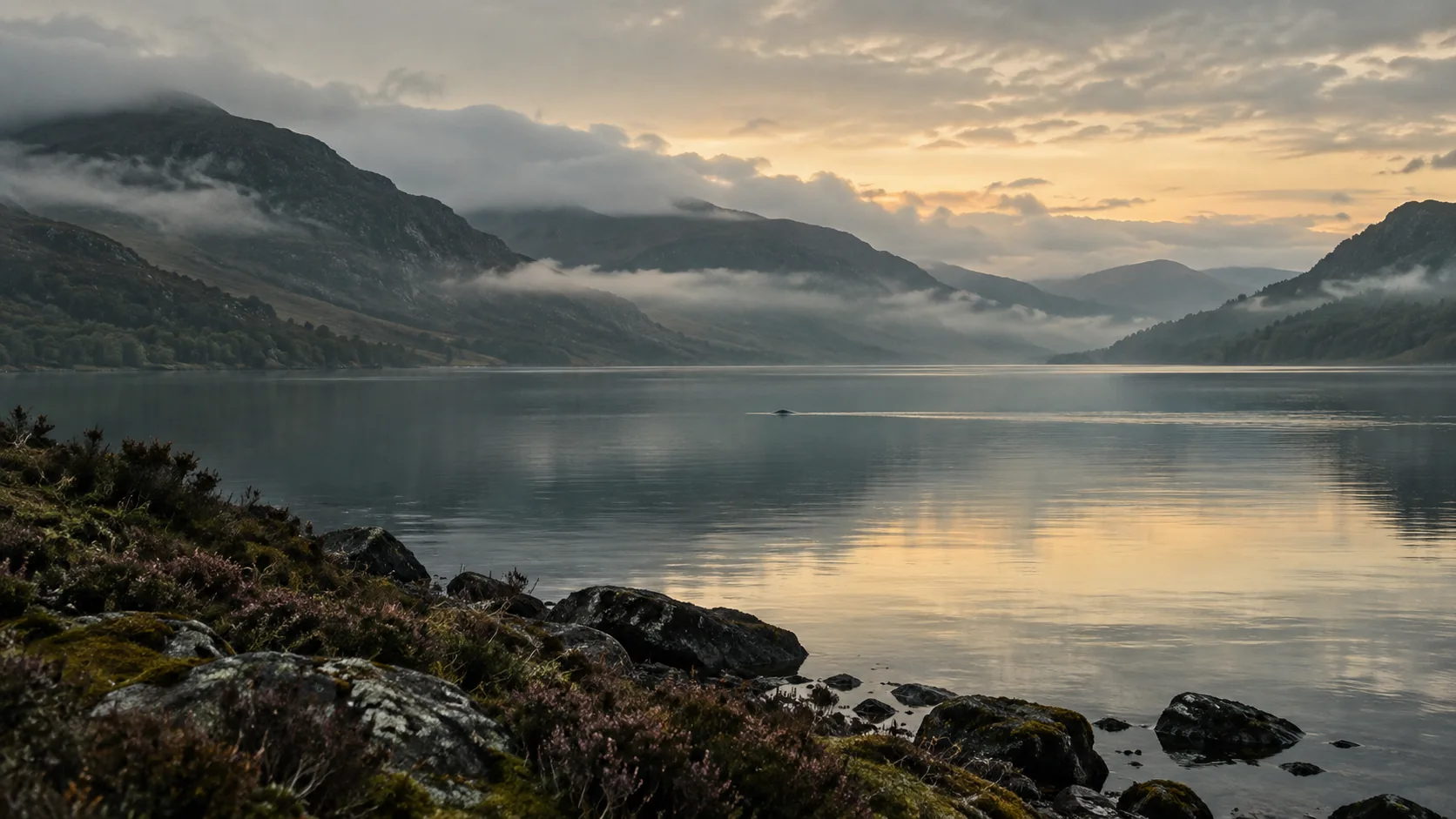
Loch Ness is a long, narrow freshwater loch in the Great Glen, deep enough that samplers in 2018 lowered gear to nearly 200 metres. Its monster has the longest paper trail of any reported lake animal and also the most testing. Neither has produced an animal. What the testing did produce, in 2019, was a residual that the people who ran it chose not to explain away.
What was reported
The earliest text usually cited is Adomnán's Life of Columba, written about a century after the saint's lifetime and before 704. In the episode, set while Columba was among the Picts, he comes to the River Ness, not the loch, and finds people burying a man bitten to death by a water beast while swimming. Columba sends his companion Lugne Mocumin into the water. The beast rises, and the saint makes the sign of the cross and orders it to go back. Adomnán gives no year; the conventional date of 565 is a later inference, and editions number the chapter differently (Book II, chapter 27 or 28).
The modern record begins in 1933. Aldie Mackay, manageress of the hotel at Drumnadrochit, and her husband saw something large in the water while driving by the loch in April; the Courier's own retrospectives give 14 April. The Inverness Courier reported the sighting on 2 May 1933 without naming the couple, describing an animal "rolling and plunging for fully a minute". On 22 July George Spicer and his wife reported a long-necked animal crossing the road ahead of their car; the Courier printed his account on 4 August. Within months the national press had arrived.
The evidence and where it is
Most of the evidence is testimony. The Official Loch Ness Monster Sightings Register, kept since 1996 by Gary Campbell and now by his daughter Paige Daley, held 1,157 accepted sightings in mid-2024, with ten accepted in 2023 and one in the first half of 2024.
The best-known photograph is not evidence of an animal. The "surgeon's photograph", published by the Daily Mail on 21 April 1934 and credited to the London physician R. Kenneth Wilson, was shown in 1994 to have been staged. Alastair Boyd and David Martin traced it to Marmaduke Wetherell, whom the Mail had earlier embarrassed over hippopotamus-foot prints; Wetherell's stepson Christian Spurling, aged 93 and near death, said he had built the head and neck on a toy submarine.
The physical record that matters most is genetic. In June 2018 a team led by Neil Gemmell of the University of Otago, with the Loch Ness Centre, the Loch Ness Project and the universities of Copenhagen, Hull and the Highlands and Islands, filtered water from shore stations and from depths of nearly 200 metres along the loch. A July 2018 report counted 259 samples; the results, presented at a news conference in Drumnadrochit on 5 September 2019, spoke of 250 and of some 500 million DNA sequences.
What investigators concluded
Official interest has been administrative rather than zoological. Files released by the National Archives of Scotland in 2010 show William Fraser, chief constable of Inverness-shire, writing to the Scottish Office on 15 August 1938 that some strange creature in the loch "seems now beyond doubt", while doubting the police had any power to protect it. Papers reported in January 2006 show civil servants in the 1980s, prompted by a Swedish inquiry about the Storsjön animal, deciding that a Nessie identified by credible scientists would fall under the Wildlife and Countryside Act 1981; a Department of Agriculture and Fisheries official noted it was no salmon and so outside the 1951 fisheries legislation.
The eDNA survey found no reptile sequence at all, which tells against the plesiosaur idea, and no shark, catfish or sturgeon. It found human, livestock, deer, badger and bird DNA, and eel DNA at nearly every station. The team reported a very significant amount of eel DNA, and Gemmell said that, on the data, giant eels "remain a plausible idea".
The leading conventional explanation
Misidentification of known things is the standard account: boat wakes, floating debris, birds, swimming deer and otters, standing waves and surface optics on a long, wind-funnelled loch, together with expectation once the story was in print. Its strength is that it needs nothing new and fits the timing: reports multiply after the 1933 press coverage, not before. Its weakness is that it is a category, not a case-by-case result; individual sightings are rarely testable after the fact.
The eel version is narrower and was proposed as early as 1933. European eels are confirmed abundant in the loch, which the survey established. What eDNA cannot measure is size, and no eel approaching the lengths described has been caught there.
What remains disputed
How old the tradition really is remains in dispute. Columba's beast lived in a river, belongs to a genre of saints' miracles over animals, and was written down a century late; sceptical historians such as Ronald Binns treat pre-1933 sightings as weak and the legend as largely a product of 1933. Some writers have also argued that the Spicer account was coloured by the film King Kong, released in 1933. And the 2019 survey left exactly the gap its authors described: plenty of eel DNA, no way to say how large any eel was.
Sources
- How an aquatic monster was driven off by virtue of the blessed man's prayer (archived) — Adomnán, Life of Columba, Corpus of Electronic Texts, University College Cork. The River Ness episode in translation.
- The Loch Ness monster legend (archived) — National Geographic, 2024. Adomnán's date, the 2 May 1933 Courier report, Spicer, Wetherell and the 1934 photograph.
- 'Long may her reign continue' (archived) — Inverness Courier, Val Sweeney, 2023. The 14 April 1933 date and the Drumnadrochit hotel.
- Just one report recorded on the Official Loch Ness Monster Sightings Register in first half of 2024 (archived) — Inverness Courier, Val Sweeney, 2024. Register totals, keepers and recent annual counts.
- The Surgeon's Photo (archived) — NOVA Online, WGBH, Stephen Lyons, 2000. Boyd and Martin's 1994 account and Spurling's confession.
- Researchers Hunting for Environmental DNA in Loch Ness (archived) — Sci.News, 2018. June 2018 sampling, 259 samples, depths, partner institutions.
- Scientists Find Significant Amount of Eel DNA in Loch Ness (archived) — Sci.News, 2019. Survey findings and Gemmell's statements, including the 1933 eel proposal.
- Loch Ness monster may have been giant eel, scientist says (archived) — UPI, 2019. The 5 September 2019 announcement, 250 samples, 500 million sequences.
- Nessie (archived) — Scottish Archives for Schools, National Records of Scotland. Transcript of the chief constable's letter of 15 August 1938 (HH1/588).
- Archives reveal belief in Loch Ness Monster — History News Network, reprinting Times Online, 2010. The 2010 release of the chief constable's letter by the National Archives of Scotland.
- Loch Ness monster a protected species — UPI, reporting The Scotsman, 2006. The 1980s Whitehall exchange, the 1981 Act and the 1951 fisheries point.

 INDEPENDENT FIELD ARCHIVE