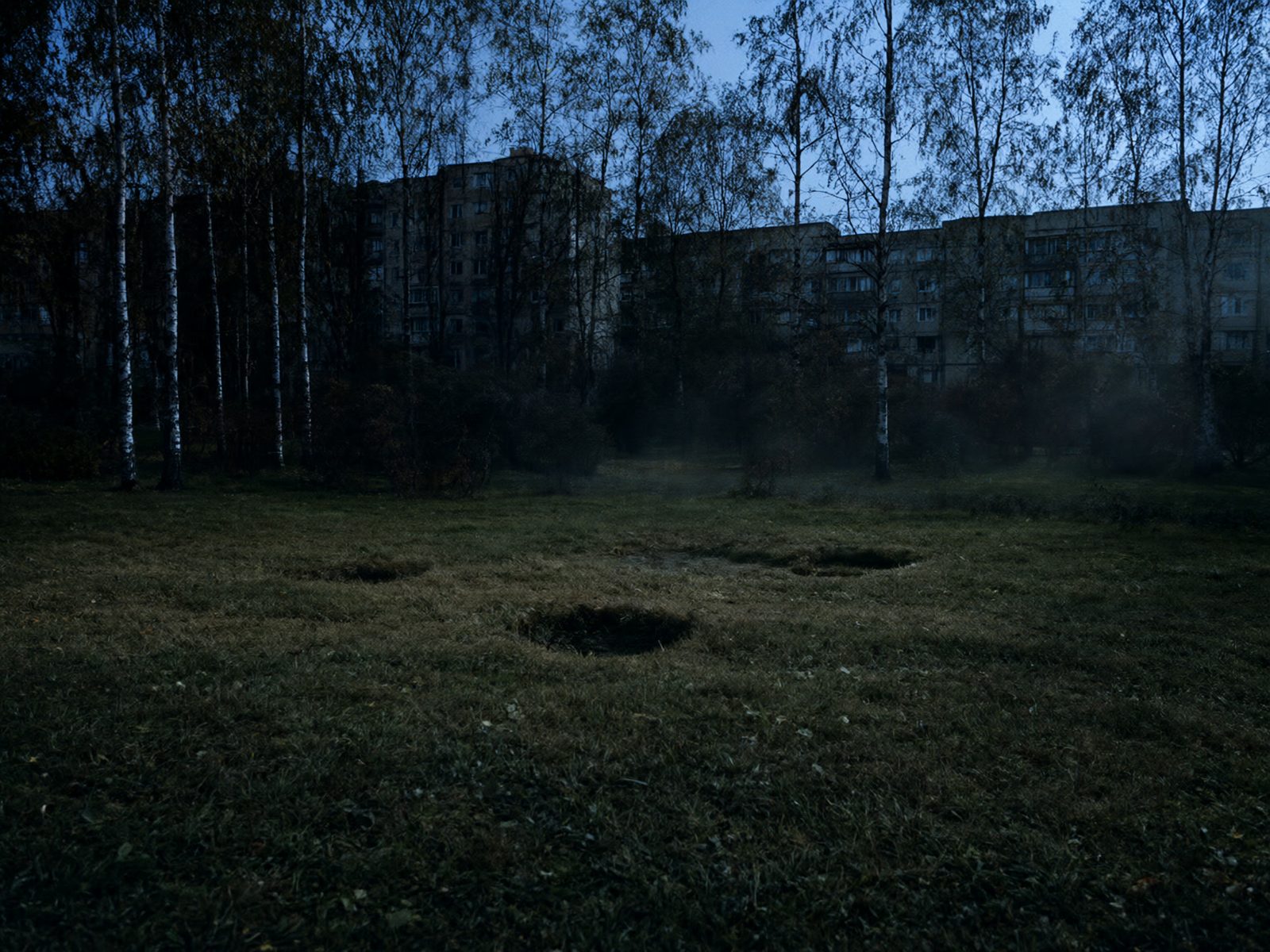
On 9 October 1989 the Soviet news agency TASS reported, as confirmed by scientists, that a craft had landed in a Voronezh park and that creatures three or four metres tall with very small heads had walked around it with a small robot. It quoted the head of the Voronezh Geophysical Laboratory on a 20-metre circle, four dents and two pieces of rock that "cannot be found on earth", the site located by "biolocation", which Kurtz calls a form of dowsing. Within two days he told AP, "Don't believe all you hear from Tass"; the rock proved to be a form of hematite, and a university commission found no anomaly in the ground or vegetation.
The leading explanation is children's imagination, amplified by a press willing to print it, which is what the Soviet evening-news crew that visited suggested. It is broadly accepted: the scientist withdrew the physical claims, and the commission's chairman put the site's raised cesium down to fallout found in many areas after Chernobyl. The object some adults saw in the sky was never identified.
AI illustration · not an evidence photograph
File
BR-0028
Date
Between 23 and 29 September 1989 · reported by TASS 9 October 1989
Place
A park in Voronezh, USSR
AssessmentD · a specific mundane cause fits better: physical claims withdrawn, no anomaly found
The record on file
Witnesses
Children of about twelve: three named by Sovetskaya Kultura, about ten by the TASS correspondent; some adults reported only an object in the sky
Evidence
The TASS dispatch quoting a local geophysical laboratory; the laboratory head's retraction to AP; 64 tests by a university commission, reported by AFP
Record made at the time
The TASS dispatch of 9 October 1989 as reported by UPI that day, quoting Genrikh Silanov of the Voronezh Geophysical Laboratory; Silanov's retraction to AP on 11 October; and the AFP report of 28 October on the commission chaired by Igor Sarotsev of the University of Voronezh, the last two read as quoted in Paul Kurtz's "Paranormal Pandemonium in the Soviet Union", Skeptical Inquirer, Spring 1990. The commission's own report has not been located.
Agency
Voronezh Geophysical Laboratory; a commission chaired by the vice-rector of the University of Voronezh
On Monday 9 October 1989 the Soviet news agency TASS put out, through its foreign service, a dispatch saying that scientists had confirmed the landing of an unidentified flying object in a park in Voronezh, a city about 300 miles south of Moscow. As UPI relayed it that day, residents had seen a "large shining disk" hover over the park and land; creatures three or four metres tall, with very small heads, had come out with a small robot, and had returned at least three times after dark. It ran across the Western press within hours, at the height of glasnost, its force coming largely from the fact that TASS had said it.
What was reported, and by whom
The landing accounts came from children. The TASS correspondent in Voronezh, Vladimir Lebedev, told UPI on 10 October that he had heard of three landings in September, the last on 27 September, that he had seen none of them himself, and that he had confirmed the story by speaking to "about 10 youngsters aged 12 to 13". He allowed that "it is not excluded that there is also fantasizing", and that adults may have added to it. A TASS report printed in Sovetskaya Kultura, as summarised by Paul Kurtz, named three schoolchildren, two boys and a girl, playing in the park at 6.30 p.m. on 27 September, who saw a pink glow in the sky and then a deep red ball about ten metres across. In that version a crowd gathered, a hatch opened, and the figures wore "silvery overalls" and "bronze boots"; one boy was frozen by a stare, and a sixteen-year-old boy was made to vanish and later reappeared. The accounts do not agree on how many children there were, from three in Sovetskaya Kultura to "a dozen" in a later UPI report. The children are not named here. Separately, some people reported only a strange object in the sky.
The record and where it is held
The case is on this shelf because records made at the time by people other than the children survive. The principal one is the TASS dispatch of 9 October, quoting Genrikh Silanov, head of the Voronezh Geophysical Laboratory, on a circle about 20 metres across with four dents 4 to 5 centimetres deep, and two pieces of rock that mineralogical analysis showed "cannot be found on earth". The site had been located by "biolocation". The TASS text itself has not been located here; it survives as reported by UPI that day, in the UPI Archives online, and as quoted from AP by Kurtz. The follow-ups are also wire copy: UPI's interviews of 10 and 11 October, and an AFP report of 28 October on a university commission, known only through Kurtz's article in Skeptical Inquirer (Spring 1990). Kurtz's AP text gives a 20-yard depression where UPI gives 20 metres. The commission's own report, and the rock samples, have not been traced.
What investigators concluded
The physical claims fell apart quickly. Kurtz reports that the "biolocation" was done by members of a local amateur group for the study of abnormal phenomena who visited the site a week after the event, and he describes the method as "a form of ESP dowsing". Silanov later said the rock was a form of hematite, very common in the Soviet Union, and on 11 October told AP: "Don't believe all you hear from Tass." By 11 October TASS itself conceded, according to UPI, that the story may have been embellished, especially the biolocation. The head of the regional health department told the New York Times, as Kurtz reports, that no witness had sought medical help. A film crew for the evening news programme Vremya went to Voronezh and found no witnesses except the children, and ended its report, in Kurtz's words, "on a very skeptical note". Finally AFP reported on 28 October that a commission chaired by Igor Sarotsev, vice-rector of the University of Voronezh, had run 16 radiometric analyses, 19 ground checks, 9 tests for micro-organisms and 20 spectrochemical measurements without finding "any anomaly either in the earth or surrounding vegetation". Sarotsev put a raised level of caesium at the site down to fallout found in many areas after Chernobyl.
The conventional explanation
The leading explanation is children's imagination, carried into a national and then international story by a correspondent and an agency willing to print it without checking. That is the reading the Vremya report pointed to, and the one Kurtz endorses. It fits well. Every physical claim was withdrawn by the scientist who made it or failed the commission's tests, the correspondent had no first-hand knowledge, and adults may have embellished the children's account by his own admission. Its weakness is that it explains the encounter, not the whole episode. Kurtz treats the sky sighting as a separate incident, and James Oberg found nothing in NASA tracking data of rocket launches or space debris to account for it.
What remains unexplained or disputed
The object some people reported in the sky in late September 1989 was never identified, and Kurtz says so plainly. How many children were involved, and what each of them actually said before the story passed through TASS, cannot now be recovered from the published record; the Russian-language accounts and the commission's report would be needed for that. Nothing in the surviving record supports a landing.
Sources
Soviets report UFO landing(archived) — UPI, 9 October 1989. The TASS dispatch: the disc, the figures and robot, Silanov's circle, dents, rock and "biolocation".
Correspondent waffles on UFO report — Gerald Nadler, UPI, 10 October 1989. Lebedev's account of his sources, the 27 September date, "about 10 youngsters aged 12 to 13".
Another UFO visit in Soviet Union — James Rosen, UPI, 21 October 1989. The correspondent's admission that a dozen youngsters were his source.
Paranormal Pandemonium in the Soviet Union(archived) — Paul Kurtz, Skeptical Inquirer 14(3), Spring 1990. Sovetskaya Kultura's account, Silanov's retraction to AP, the Vremya crew, Oberg's check, and the AFP report on the commission.
Corrected The full file: The separate sky sighting was attributed to 'some adults'; Kurtz says only 'some people', and the text now says that in both places.
Corrected The witnesses are now children of about twelve, three named by Sovetskaya Kultura and about ten by the TASS correspondent; the file previously said three schoolchildren were the only witnesses a television crew could find.
Added The full file, a long-form write-up with its sources, added.
Also filed under High strangeness
Skinwalker RanchThe Ranch in the Uintah Basin · About 1995–2012 · ranch bought 1996, program ended 2012
The Varginha incidentThe Figure by the Wall in Varginha · 20 January 1996 · Army inquiry 1997

 INDEPENDENT FIELD ARCHIVE