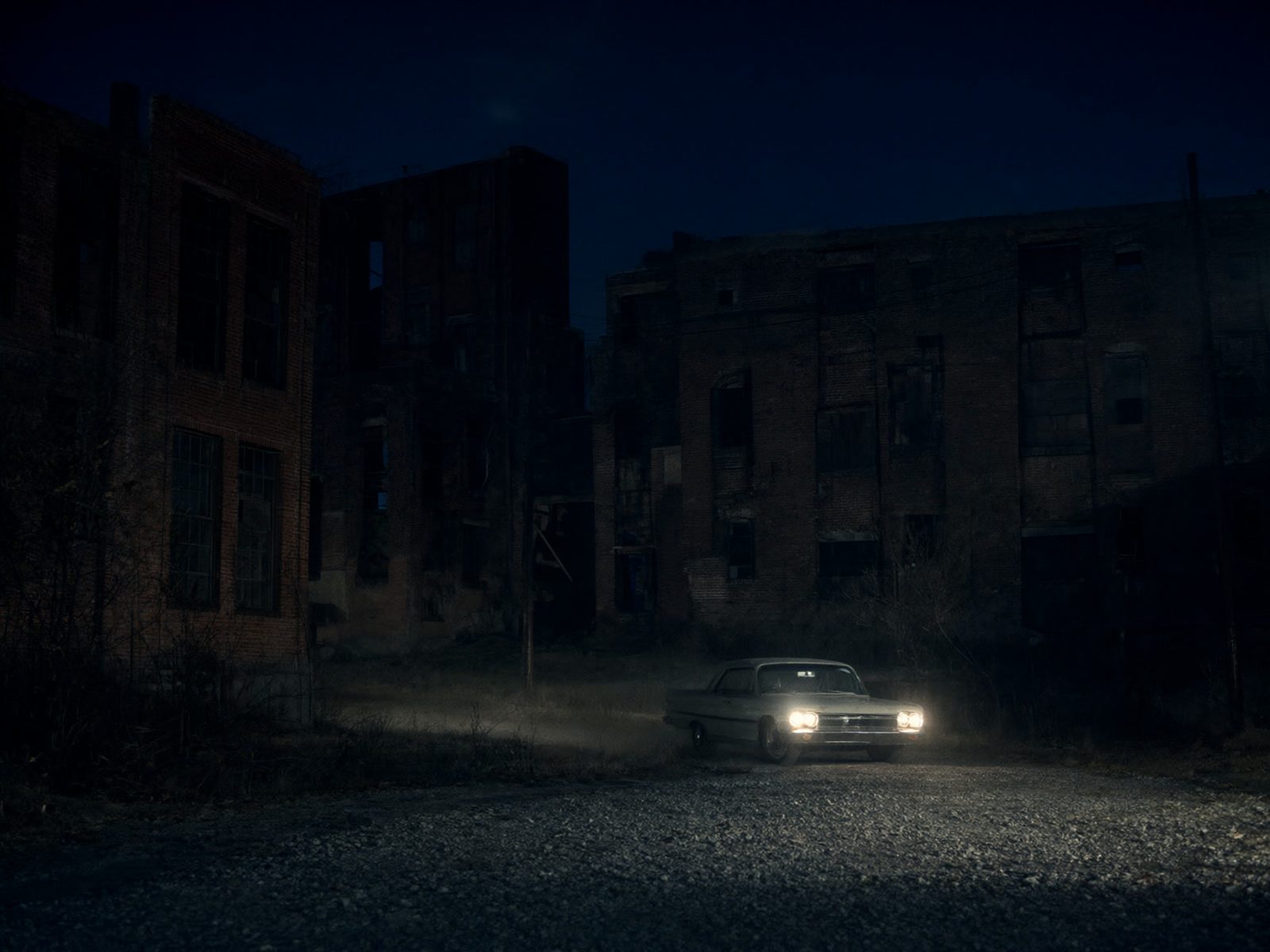
High strangeness / The former TNT works, Point Pleasant, Mason County, West Virginia
The Thing in the TNT Area
Two Point Pleasant couples told the Register that late on 15 November 1966, near an empty power plant in the old TNT area, they had seen a grey, man-sized figure with wings and red eyes that glowed in their headlights, and that it followed their car. Sheriff's deputies and city police went to the scene at about 2 a.m. and "were unable to spot anything". One of the men called it "an animal but nothing like I've seen before"; the links to UFOs, men in black and the Silver Bridge collapse of December 1967 come mainly from John Keel's book of 1975.
The conventional explanation is a large bird: some argued it was a sandhill crane off its usual range, by the West Virginia Encyclopedia's account. It was never tested against the witnesses' description of a figure six or seven feet tall with a ten-foot wingspan.
AI illustration · not an evidence photograph
File
BR-0026
Date
15 November 1966, about midnight · further reports for about a year
Place
The former TNT works, Point Pleasant, Mason County, West Virginia
AssessmentC · reported: four witnesses together, a press-only record
The record on file
Witnesses
Two young married couples in one car, by the Point Pleasant Register's report; sheriff's deputies and city police who searched the scene; further witnesses over the following year, 26 reports in all by the West Virginia Encyclopedia's count
Evidence
A next-day newspaper report of the sighting and the police search; no physical evidence
Record made at the time
"Couples See Man-Sized Bird...Creature...Something", Point Pleasant Register, 16 November 1966, the next day, reporting that sheriff's deputies and city police searched the scene that night; read as Mark Turner's transcription, not the page itself. No police file has been located, and no Project Blue Book file for Point Pleasant was found.
Agency
Mason County sheriff's deputies and Point Pleasant city police
Late on Tuesday 15 November 1966, two young married couples from Point Pleasant, West Virginia, were driving through the old TNT area north of the town, a wartime munitions works that by then held the McClintic Wildlife area and a cluster of empty plant buildings. Near a disused power plant, they said, something stood up in their headlights. By the next morning they had told the police and the local paper, and the story that would later be called Mothman had begun.
What was reported
The Point Pleasant Register of 16 November named the men as Steve Mallette and Roger Scarberry, riding with their wives in Scarberry's car between 11.30 p.m. and midnight. They described a grey figure about six or seven feet tall with a ten-foot wingspan and red eyes about two inches across, which glowed only when the headlights caught them. It was "a clumsey runner" but fast in the air, and it followed the car towards the National Guard armoury on Route 62, then seemed to be waiting when they came back. Mallette said it was "like a man with wings"; the paper's opening quotation was "It was a bird... or something."
Reports followed at once. On 17 November the Register said the Mason County sheriff's office had a second sighting, about 10 p.m. on 16 November, from Raymond and Cathy Wamsley, Marcella Bennett and Ricky Thomas near the Thomas home in the TNT area. Wire stories carried a Doddridge County contractor, Newell Partridge, whose German shepherd ran at two red reflections his flashlight picked up in his meadow and did not come back. e-WV: The West Virginia Encyclopedia counts 26 sightings over about a year; Joe Nickell gives the span as November 1966 to November 1967.
The record and where it is held
The record that puts this case on the Investigated shelf is the Register's next-day report that "Sheriff's deputies and City Police went to the scene about 2 o'clock this morning but were unable to spot anything", with Deputy Millard Halstead quoted on a disturbance of dust he had seen. It is read here as Mark Turner's transcription, archived from westva.net by the Internet Archive, with his transcriptions of other papers from the same fortnight; the original page was not seen, and where the paper's bound file or microfilm is now held is not established here. No police file has been located, and no Project Blue Book file for Point Pleasant was found.
What investigators concluded
No investigation reached a finding. Sheriff George Johnson said the couples had "seen something" and suggested an oversized "shitepoke", a heron. Members of a high-school science club in Lawrence County, Ohio, suggested one of the gas-filled balloons they had released to study air currents. By 19 November the Register was reporting that Dr Robert Smith of West Virginia University had proposed a sandhill crane and that Halstead, having compared descriptions with him, thought it might fit. The case's later shape owes most to John Keel's The Mothman Prophecies (1975), which joined the bird reports to UFO sightings, men in black and prophecy.
The Silver Bridge between Point Pleasant and Kanauga, Ohio, collapsed at about 5 p.m. on 15 December 1967. The National Transportation Safety Board found that 46 people died and 31 of the 37 vehicles on it fell, and traced the collapse to a cleavage fracture in eyebar 330, caused by a flaw that grew over the bridge's 40-year life through stress corrosion and corrosion fatigue, in a place inaccessible to visual inspection. The link between the bridge and the creature belongs to the later legend, not to the 1966 record or the Board's report; e-WV notes that sightings diminished after the collapse, and some local telling ties both to a curse attributed to the Shawnee leader Cornstalk.
The conventional explanation
The leading explanation is a large bird misjudged at night. Smith's sandhill crane has the merit of size, about six feet, and red on the head. Against it, Ohio University zoologists said at the time that there was no known record of the species in the area, and a witness shown a picture said, "My God, that's not the thing we saw." Nickell argued in 2002 for the barn owl: red eyeshine in headlights, a short neck that can look headless in silhouette, long legs, and a habit of roosting in old buildings like those of the TNT plant. By Audubon's 2018 account he later preferred the barred owl, which has stronger red eyeshine and lives on the refuge. The owl explains the eyes and the setting well, and the size badly: neither owl is near six feet, so the argument depends on witnesses overestimating size at night, which Nickell asserts rather than shows for this case.
What remains disputed
Nobody tested either bird against the four witnesses. The two men were explicit that they had not been drinking, and Mallette said what they saw was "an animal but nothing like I've seen before". The size, the speed and the pursuit of the car are the parts no candidate fits; the eyes and the shape are the parts an owl fits. Nickell himself allowed that many reports are unlikely to share one cause. The case stays open, with a large bird the most likely answer for the first sighting and the reports of the following year never examined one by one.
Sources
Couples See Man-Sized Bird...Creature...Something — Point Pleasant Register, 16 November 1966, transcribed by Mark Turner (Internet Archive). The first report, the witnesses' description and the police search.
City Getting 'The Bird,' Want It Or Not — John Samsell, Point Pleasant Register, 17 November 1966, Turner transcription. Second sighting via the sheriff's office, the sheriff's heron theory, the Partridge report.
Our 'Bird' Has Law On Its Side — Point Pleasant Register, 19 November 1966, Turner transcription. Smith's sandhill crane and Halstead's comparison.
Is Mysterious Creature Balloon Or Crane? — Athens Messenger, 26 November 1966, Turner transcription. Ohio University's objection to the crane, the science-club balloons and the witness's rejection of the crane.
Mothman(archived) — Gordon Simmons, e-WV: The West Virginia Encyclopedia, revised 2024. The count of 26 sightings, the crane suggestion, Keel and the bridge legend.
Silver Bridge collapse, 25 years on(archived) — Terry Wallace, Associated Press, Sunday Gazette-Mail, 13 December 1992 (West Virginia Archives and History). Second source for the date, deaths and vehicles.
'Mothman' Solved!(archived) — Joe Nickell, Skeptical Inquirer, March/April 2002. The barn-owl argument and the span of the reports.
Corrected The full file: The Register's transcription quotes Newell Partridge as seeing 'two red reflection' in his meadow, not 'red reflectors'; the quotation is now a paraphrase.
Corrected The full file: No cited source has UPI saying a heron could not explain a speed of 100 miles an hour; the claim has been removed.
Corrected The full file: The balloon theory came from members of a high-school science club in Lawrence County, Ohio, not from a club adviser; the text now says so.
Corrected The full file: The Register reports only the two men saying they had not been drinking, and the quoted description was Mallette's; the text now attributes both correctly.
Sources The full file: The Athens Messenger article is dated 26 November 1966; the source line now gives the full date.
Added The full file, a long-form write-up with its sources, added.

 INDEPENDENT FIELD ARCHIVE