High strangeness / Kelly Station, north of Hopkinsville, Christian County, Kentucky
The Night at Kelly Station
Late on 21 August 1955 the occupants of a farmhouse at Kelly drove to the Hopkinsville police station and reported small, large-eyed figures around the house, which the men said they had shot at for hours with little effect. City police, state troopers, deputies and four military policemen searched the farm until after 2 a.m. and found no tracks, no landing mark, and nothing but a hole in a window screen where a shot had been fired. In a statement taken the next day, the householder described "a bright silver object about two and a half feet tall" and "this little man that looked like a monkey".
Two conventional explanations exist. The reserve major who took the statement suggested in 1957 that the household, excited after a religious meeting, had a picture of "a monkey, painted silver" in mind, or that a monkey had escaped from a circus. Joe Nickell later argued for a meteor and a pair of great horned owls, as summarized by Brian Dunning. Neither was put to the witnesses, and the Air Force card adopts neither.
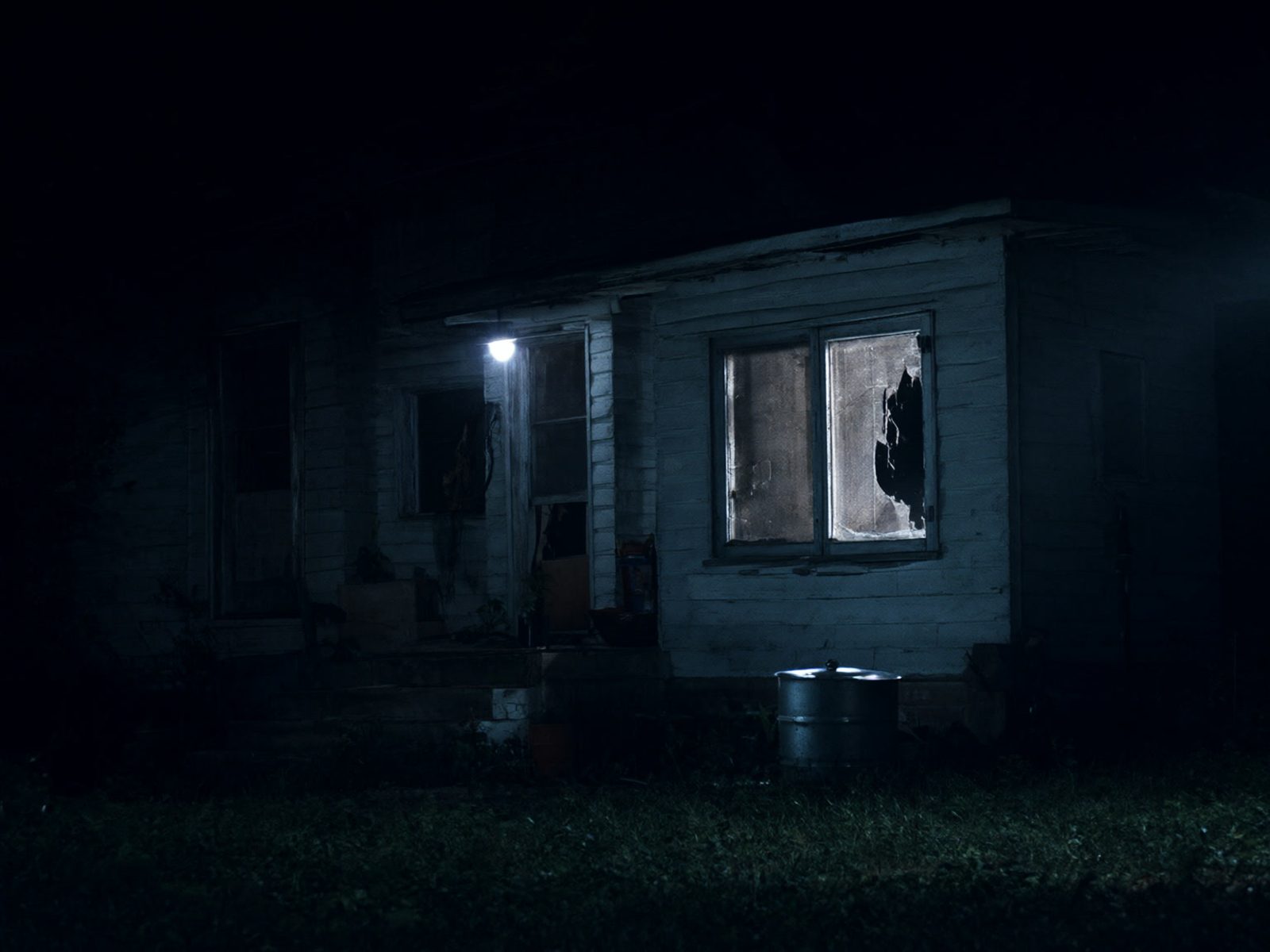
AI illustration · not an evidence photograph
File
BR-0024
Date
Night of 21–22 August 1955
Place
Kelly Station, north of Hopkinsville, Christian County, Kentucky
AssessmentB · documented: police attended and a statement survives, no physical trace
The record on file
Witnesses
The farmhouse household and their visitors, ten to twelve people including several children by the press count; more than a dozen city, county and state officers and four military policemen, who searched the farm that night
Evidence
A same-day newspaper report of the police search; a statement signed the next day by the householder and witnessed by an Air Force reserve major; Air Force correspondence of 1957
Record made at the time
The Kentucky New Era's report of 22 August 1955 on the overnight police search; and, in the Project Blue Book file, a certified copy of the householder's handwritten statement dated 8/22/55 and witnessed by Maj. John E. Albert, with Air Force correspondence of August to October 1957 recording that the incident had "never been officially reported to the Air Force".
Agency
Hopkinsville police, county sheriff's deputies and Kentucky State Police; an Air Force inquiry in 1957
On the evening of Sunday 21 August 1955 the household of a farmhouse near Kelly, north of Hopkinsville in Christian County, Kentucky, said that small, shining figures had come out of the fields and besieged the house for hours. At about 11 p.m. two carloads of adults and children reached the Hopkinsville police station, and within the hour more than a dozen officers were at the farm. Two years later the Air Force assembled a file.
What was reported
The Kentucky New Era of 22 August gives the account officers took from the "still terrified and excited" families. At about 7 p.m. one of the men, fetching water, saw what looked like a flying saucer come down in a field about a city block behind the house. Soon afterwards small figures with big heads, long arms, huge eyes and outsized hands approached. Sutton, with a shotgun, and Taylor, with a .22 target pistol, fired at them through a window and in the yard; one knocked down by a shotgun blast "did not appear hurt." The men claimed four boxes of .22 shells; a neighbour heard about four shots.
Basic details vary. The paper puts the farm eight miles north of Hopkinsville, the Air Force file six, a notarised document in the same file ten. The 1955 report has Cecil (Lucky) Sutton occupying the house; a 1957 article in the same paper calls it the Gaither McGehee farm. Later accounts name the household as Glennie Lankford, her sons Elmer "Lucky" and J. C. Sutton, their wives, and a visitor, Billy Ray Taylor, with his wife. The paper counted ten to twelve people present, several of them children.
The record and where it is held
Two records made at the time by people outside the household survive. The first is the New Era report, republished unaltered by the paper in 2017. City police under Chief Russell Greenwell, state troopers, deputies from two counties and four military policemen stayed until after 2 a.m. and found no tracks, no landing mark, and a hole in a window screen where a shot had been fired; "all officials appeared to agree that there was no drinking involved."
The second is the Project Blue Book file at the National Archives at College Park (Record Group 341, microfilm T1206, roll 23), catalogued under a wrong title, "Old Greenwich, Connecticut, August 1955". It holds a 1957 certified copy of a handwritten statement dated 8/22/55 by the household's 50-year-old matriarch, name redacted, witnessed by Maj. John E. Albert. She describes "a bright silver object about two and a half feet tall" at the back door at about 10:30 p.m., and at 3:30 a.m. a small shining figure with its hands on a window screen. The file also holds a typescript by a Hopkinsville radio man, his name likewise redacted, who interviewed the women within seven hours and the men within fifteen, drew the figures to their direction, and searched the field and woods without result.
What investigators concluded
On 29 August 1957, expecting a magazine article, the Air Technical Intelligence Center asked Campbell Air Force Base for facts, noting that the incident "has never been officially reported to the Air Force". The base replied on 1 October, citing its former adjutant, that "an official investigation was never ordered" and that neither sheriff nor police had a report on file. Albert's statement of 26 September 1957 says he drove to the farm on the morning of 22 August. He put the report down to excitement after a religious meeting and a mail-order picture of "a monkey, painted silver", or to a monkey escaped from a circus. A Blue Book officer's report adds that he and J. Allen Hynek thought escaped monkeys possible if a rumoured circus train had been near. The index card reads "No Case". Brian Dunning found a hoax listing only in undated Air Force lecture notes.
The leading explanation: owls and a meteor
The leading conventional explanation is Joe Nickell's, published in the Skeptical Inquirer in 2006, with a similar analysis by the French researcher Renaud Leclet: the light was a meteor, the figures a pair of great horned owls. The owl fits: up to about 64 cm long, with yellow eyes, ear tufts and talons, perching in trees and on roofs. The radio man's notes describe figures that floated down from the roof, flipped over when hit, scurried off, and kept away from the porch lights.
The weaknesses are real. The argument came decades later and was never put to the witnesses. It must turn birds into upright figures about three feet tall, approaching with raised hands. Nickell read the metallic sheen as moonlight on feathers, but the moon was four days past new. Great horned owls breed between November and April, which strains the idea of birds defending a nest in late August. Albert's monkey had no recorded escape behind it. A 2014 paper in Frontiers in Psychology calls the witnesses "probably intoxicated", against the officers' agreement that night that nobody had been drinking.
What remains disputed
The New Era of 22 August describes a landing saucer; Dunning, citing a reporter's interviews, says Taylor first spoke only of a bright shooting star. A memo headed with Hynek's name, dated 10 September 1958 on its copy but cited elsewhere in the file as 1956, says a Kentucky State Police report was on file in Frankfort with Trooper Riley's case report. It was not found for this write-up. Beyond a screen hole, no physical trace survives.
The Kelly-Hopkinsville Encounter(archived) — Brian Dunning, Skeptoid #331, 2012. The Nickell and Leclet owl-and-meteor argument, the shooting-star reading and the hoax listing in the lecture notes.
Corrected The full file: Animal Diversity Web gives November to April as the great horned owl's breeding season, not its laying season; the text now says breed.
Corrected The full file: Campbell Air Force Base's 1957 statement that an official investigation was never ordered came from its former adjutant, to his knowledge; the text now attributes it.
Added The full file, a long-form write-up with its sources, added.

 INDEPENDENT FIELD ARCHIVE